
Most of what you'll read about AI in customer experience was written by people who have never sat on a contact centre floor. This guide is different. I've spent twenty years designing, deploying, and repairing AI in customer experience across Australia and Asia Pacific, for banks, airlines, insurers, telcos, and government. I wrote the book on it, literally. This is what AI in CX actually is, where it genuinely works, why it so often fails, and how to approach it if you're responsible for the outcome.
What AI in customer experience actually means
AI in customer experience is the use of artificial intelligence to shape how an organisation listens to, understands, responds to, and resolves things for its customers. That covers chatbots and voice assistants, but it goes much further: the AI that helps a human agent find an answer mid-call, the system that summarises a conversation so the customer never repeats themselves, the analytics engine that spots a failing process before it becomes a complaint spike, and increasingly, agentic systems that complete tasks on a customer's behalf.
Here's the framing most definitions miss. Customers don't contact you because they want information. They contact you because something in their world has stopped behaving the way they expected. A customer is not experiencing a "billing query." They are experiencing concern about money. By the time anyone reaches your AI, an expectation has already been violated. Every AI interaction in customer experience happens inside a moment of interruption.
AI in customer experience is not primarily a technology problem. It is a design problem, an operational problem, and increasingly a governance problem.
The technology is the easy part. Getting it to behave well inside a real organisation, with real customers who are already mildly annoyed, is the work.
Where AI shows up in customer experience
AI in CX is not one thing. It's a family of capabilities, each with different strengths, risks, and readiness requirements.
Chatbots and virtual assistants. The most visible layer. Done well, they resolve high-volume, well-bounded tasks instantly, at any hour. Done badly, they become the most efficient frustration engine your brand has ever operated.
Voice AI. The hardest channel by a wide margin. No screen, no buttons, no ability to skim. Voice punishes weak design faster than any other channel because the customer has nowhere to hide from a bad experience and neither do you.
Generative AI. The arrival of large language models changed how conversational systems sound. It did not change the fundamentals of conversation. Generative AI amplifies design decisions: a well-designed system becomes dramatically more helpful, a poorly designed one becomes dramatically more dangerous. Same model, same interface, opposite outcomes. The difference is design judgement, not model capability.
Knowledge and RAG. Retrieval-augmented generation lets AI answer from your actual content rather than its training data. Which means the honest question is rarely "is the model good enough" and almost always "is our knowledge good enough." Most organisations discover their documentation was written for lawyers, not customers, on day one of a RAG project.
Agent assist. AI that helps humans work better: surfacing answers, drafting responses, summarising interactions. Often the highest-value, lowest-risk starting point, because a human remains between the model and the customer.
Agentic AI. Systems that don't just answer but act: processing a refund, rebooking a flight, changing an account. This is where customer experience is heading, and where governance stops being optional. More on this below.
What AI genuinely does well in CX
I'm sceptical of vendor promises, but I'm not a sceptic of the technology. Deployed into a ready environment, AI in customer experience delivers real, measurable outcomes:
- Availability. Customers get resolution at 11pm on a Sunday without staffing a night shift.
- Consistency. The thousandth answer is as accurate as the first. Humans have bad days; well-governed systems don't.
- Speed to competence for humans. Agent assist compresses the time it takes a new agent to become a good one, which matters enormously in high-attrition environments like BPO.
- Genuine cost outcomes. One program I worked on at a major Australian bank produced roughly $6 million in verified savings. Not projected. Verified. The distinction matters, because most business cases in this space quote the former and quietly never audit the latter.
- Signal at scale. Every AI conversation is data about what's confusing your customers. Organisations that listen to it fix upstream problems. Most don't, which brings us to the failures.
Why AI in customer experience fails
This is the section most vendor content won't write, because the honest answer implicates the buyer as much as the product.
The containment trap
The metric that dominates AI in CX business cases is containment: the percentage of contacts the AI handles without a human. Containment is a misleading metric. A contained contact is not necessarily a resolved one. Customers give up, go around the bot, call back tomorrow, or churn quietly. The dashboard records a success. The customer records a failure. Repeat contact rises underneath a containment number that looks healthier every quarter.
When the dashboard rewards containment, deflection, and cost per contact, AI will be optimised to end conversations rather than resolve them. The saving is real in the reporting and illusory in practice. If you take one thing from this guide: measure resolution and repeat contact, not containment.
AI inherits its environment
AI doesn't define the conditions it operates in. It inherits them. Contact centres are pressure systems built over decades, shaped by operating models, KPIs, technology layers, and incentives that long predate generative AI. Deploy AI into a fragmented, misaligned environment and it doesn't fix the fragmentation. It automates it at scale. The flaws don't disappear. They get faster, more consistent, and more confident-sounding.
Bad processes don't become good processes when wrapped in a model. They become faster bad processes. I've written about this pattern in depth in AI Inherits Its Environment, because it explains the majority of underperforming AI CX programs I'm asked to look at.
Readiness treated as a phase
Most programs treat organisational readiness as a workstream: something to run alongside the build, or clean up after launch. Readiness is not a project phase. It is the project. Knowledge quality, escalation design, metric alignment, ownership of the seams between systems: these determine the outcome before the first prompt is written.
The brief is usually wrong
The use cases executives ask for are rarely the use cases that create value. Decision makers see the visible symptom (call volume, wait times) and prescribe the visible fix (a bot on the website). The actual opportunity usually sits somewhere less glamorous: the broken process generating the calls, the knowledge base agents can't search, the handoff where context dies. Part of doing this well is surfacing what the organisation doesn't know it doesn't know.
Launch treated as the finish line
Conversational systems live in moving worlds. Customers change how they speak. Products change, policies update, edge cases multiply. A system that was accurate at launch decays not because it was poorly designed, but because it was treated as finished. Launch is not the end of the work. It's the moment the work becomes real.
What this looks like in the field
Theory is cheap, so here's what two decades of AI in customer experience across APAC actually looks like.
I've worked on and around some of the region's best-known virtual assistant and AI deployments: major Australian banks, one of the earliest airline virtual assistants anywhere, insurers, health funds, telcos, global logistics and aviation, government, and automotive across Asia.
The pattern across all of them is the same. Success correlated with environment, not model sophistication. The programs that delivered were the ones where someone owned the customer journey end to end, where metrics rewarded resolution, and where the knowledge behind the AI was treated as a product rather than an archive.
The most instructive lessons often come from the least glamorous places. Spend a day on a BPO floor in Manila and you'll learn more about why your AI is failing than a quarter of dashboard reviews will tell you. The agents handling your overflow already know exactly which intents break, which policies contradict each other, and which customers the bot infuriates. Most organisations deploying AI never ask them. The intelligence is sitting right there, on the floor, wearing a headset.
How to approach AI in customer experience
If you're an executive responsible for an AI CX outcome, here is the approach I'd give you across a whiteboard.
1. Start with the interruption, not the technology. Map the moments where customer expectations break. That map, not a vendor's capability matrix, is your use case pipeline.
2. Audit the environment before you deploy into it. Journey fragmentation, metric alignment, knowledge quality, escalation paths. AI will inherit all of it. Fix what you can first, and consciously accept what you can't.
3. Fix your measurement before it fixes your behaviour. Resolution rate, repeat contact within seven days, customer effort, and how customers feel afterwards. Customer experience should be measured by how customers feel, not just by how processes perform. If containment is your headline metric, your AI will learn to hang up politely.
4. Design the handoff like it's the product. Because it is. Every AI system will hit its limits. What happens next defines the experience. Context must travel with the customer. An escalation where someone repeats their story for the third time is not an escalation, it's a penalty.
5. Treat knowledge as infrastructure. Your AI is only as good as the layer behind it. Content ownership, review cycles, and retirement processes are unglamorous and decisive.
6. Grant autonomy deliberately. As agentic AI arrives, remember that autonomy does not emerge from systems. It is granted by organisations. Every agentic deployment is a transfer of authority, and authority comes with obligation. Decide explicitly what the system may do, prove reversibility, and put a human in the loop wherever consequence is high. If no one governs this transfer, the obligation lands on the customer.
7. Staff the aftermath. Budget for the operating model after launch: analytics, iteration, governance, tuning. The organisations that win at AI in customer experience are not the ones with the best launch. They're the ones with the best week 40.
Where AI in customer experience is heading
Three shifts matter for anyone planning beyond the next quarter.
From answering to acting. The centre of gravity is moving from AI that answers questions to AI that completes tasks. That raises the ceiling on value and the floor on governance simultaneously.
From components to systems. Customers never experience components. They experience systems. A conversation that feels seamless to a customer might traverse an IVR, a bot, an agent, and a back-office process. The organisations investing in orchestration across those seams will pull ahead of those buying capabilities one module at a time.
From answering customers to becoming answerable. The most mature view I can offer: AI shouldn't only answer customer questions. It should help the business become more answerable. Every conversation your AI has is evidence about where your organisation is confusing, contradictory, or slow. The real prize isn't deflecting that signal. It's acting on it.
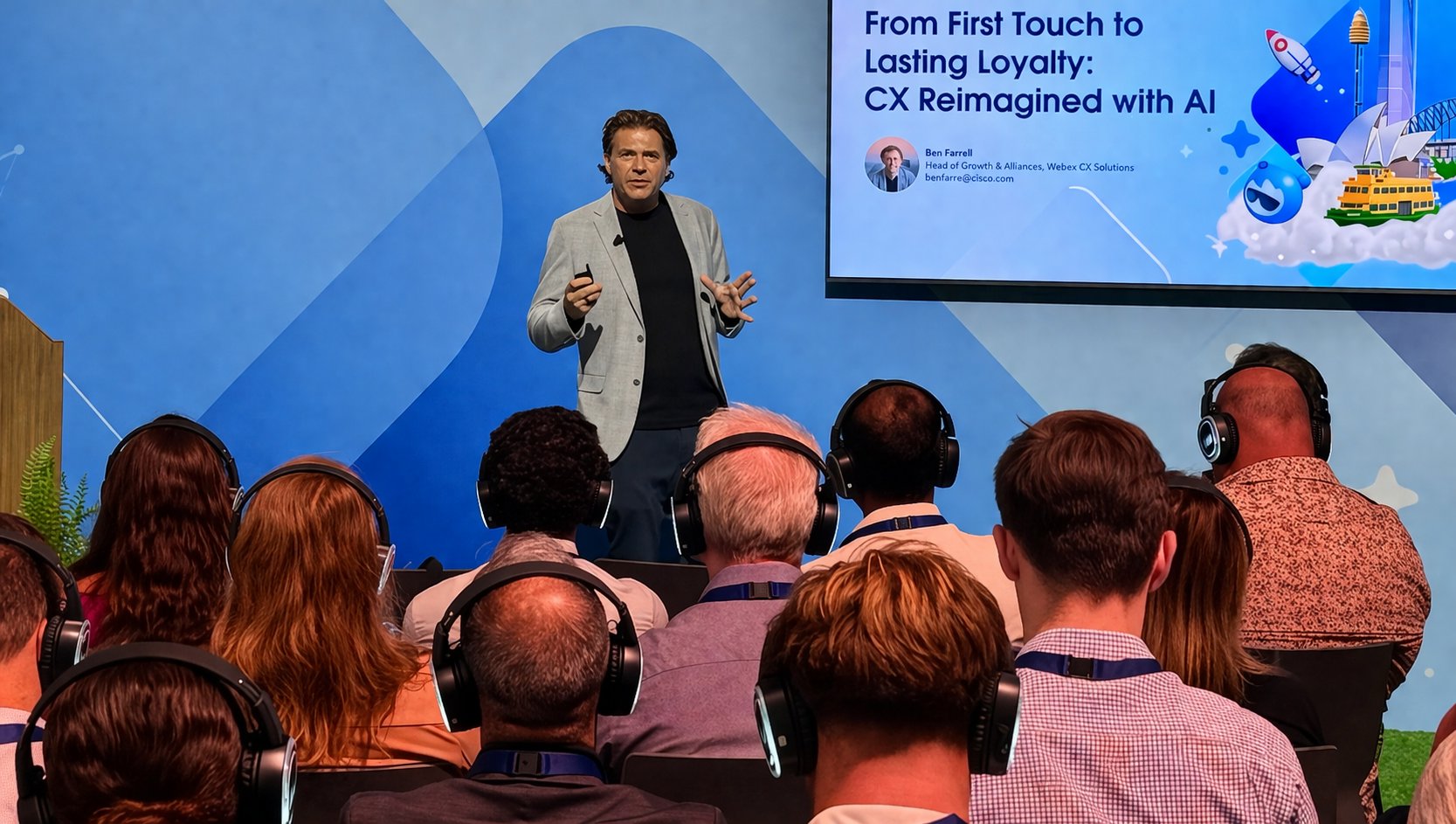
Ben Farrell covers these themes on stage, including his agentic AI keynote for executives and boards. See all AI in CX keynote topics.
Frequently asked questions
What is AI in customer experience?
AI in customer experience is the application of artificial intelligence, including conversational AI, generative AI, and agentic systems, to how organisations understand, respond to, and resolve things for customers. It spans customer-facing tools like chatbots and voice assistants, and behind-the-scenes capabilities like agent assist, knowledge retrieval, and conversation analytics.
Does AI improve customer experience or make it worse?
Both, and the deciding factor is rarely the technology. AI amplifies the environment it's deployed into. In organisations with aligned metrics, good knowledge, and well-designed escalation, AI measurably improves speed, availability, and consistency. In fragmented environments, it automates existing problems at scale.
What are the main uses of AI in customer experience?
The most common are virtual assistants and chatbots, voice AI, agent assist for human teams, knowledge retrieval (RAG), conversation summarisation, quality management and analytics, and emerging agentic AI that completes tasks end to end.
Why do AI customer experience projects fail?
The most common causes are measuring containment instead of resolution, deploying into broken processes, treating organisational readiness as an afterthought, poor knowledge quality, and weak escalation design. Model choice is rarely the decisive factor.
Should we replace human agents with AI?
No, and the framing is wrong. The strongest results come from AI and humans doing what each does best: AI handling well-bounded, high-volume tasks and augmenting human agents with knowledge and context, while humans handle complexity, emotion, and judgement. Organisations that frame AI purely as headcount reduction typically damage experience and see the cost return through repeat contact and churn.
How should we measure AI in customer experience?
Prioritise resolution rate, repeat contact within a defined window, customer effort, and post-interaction sentiment. Treat containment and deflection as diagnostic metrics, not success metrics. And measure how customers feel, not just how processes perform.