환영합니다 — This page is written in English. 한국어로 문의하시려면 hello@benfarrell.ai로 연락해 주세요.

AI CX Consulting · South Korea
APJC · Vendor-neutral

Independent AI consultant · Speaker at Getting CX Right, Seoul · 20+ years in enterprise CX across APJC

Korea has one of the world's most advanced tech sectors. Its contact centres are ready to catch up.

South Korea is an AI-first economy with world-class ambition and sovereign AI programmes to match. Yet its contact centre sector still carries one of the largest on-premise infrastructure bases in the region — a legacy of deep domestic vendor relationships, complex data localisation expectations, and systems that were built to last rather than to evolve. The gap between Korea's AI capability and its contact centre reality is now the most interesting strategic problem in the market.

20+
Years in enterprise CX
Seoul
Speaker, Getting CX Right
6
AI maturity archetypes
0
Vendor affiliations
01 / The Korea context

World-class AI ambition. Legacy infrastructure reality.

South Korea's contact centre software market is projected to nearly quadruple by 2033, growing from USD 779 million in 2024 to almost USD 2.9 billion — one of the fastest growth rates in Asia. The combination of sovereign AI investment, hyperscaler partnerships, and a deeply tech-literate enterprise sector means the momentum is real. The friction is the installed base that has to move before that momentum can be fully captured.

01

The on-premise problem

Korea's contact centre sector was built on deeply embedded, locally developed on-premise systems — particularly in financial services and telecommunications, where data localisation expectations and regulatory complexity made on-premise the default. Those systems are now the primary barrier to accessing AI capabilities that are predominantly cloud-native. The migration decision is less a technology question than a risk governance and vendor relationship question. And it is overdue.

02

Korean: a genuinely hard AI language

Korean is an agglutinative language — words are built from multiple morphemes, creating vocabulary variation that challenges models trained primarily on English. More significantly, Korean has a complex honorific system where the entire speech level changes depending on the relationship between speakers. Appropriateness in Korean conversation depends on hierarchy, familiarity, and contextual emotional tone simultaneously. AI that handles Korean well needs to navigate this social layer, not just parse the words. Most international platforms underestimate this.

03

Sovereign AI and the local model question

Korea is building its own large language models. SKT's A.X series, Naver's HyperClova X, LG's Exaone, and Kakao's Kanana are all being positioned for enterprise deployment — explicitly as sovereign alternatives for financial institutions and government entities that prefer on-premise or domestically hosted AI. KT has partnered with Microsoft on AI infrastructure at scale. The Korean AI ecosystem is not waiting for global vendors to get Korean right. It is building its own answer. That creates a platform selection landscape unlike any other market in APJC.

02 / Korea experience

In the room with Korean enterprise CX leaders.

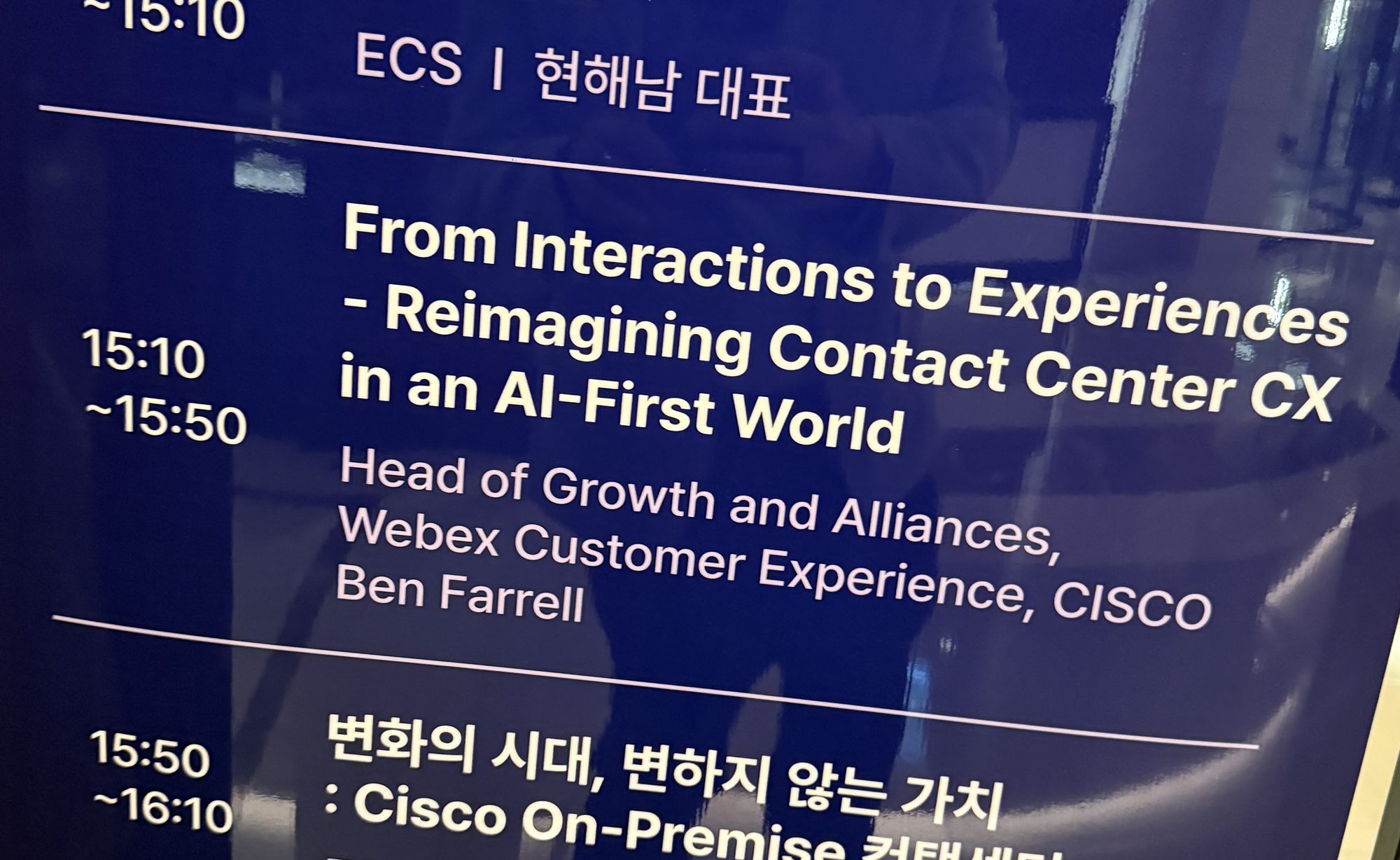
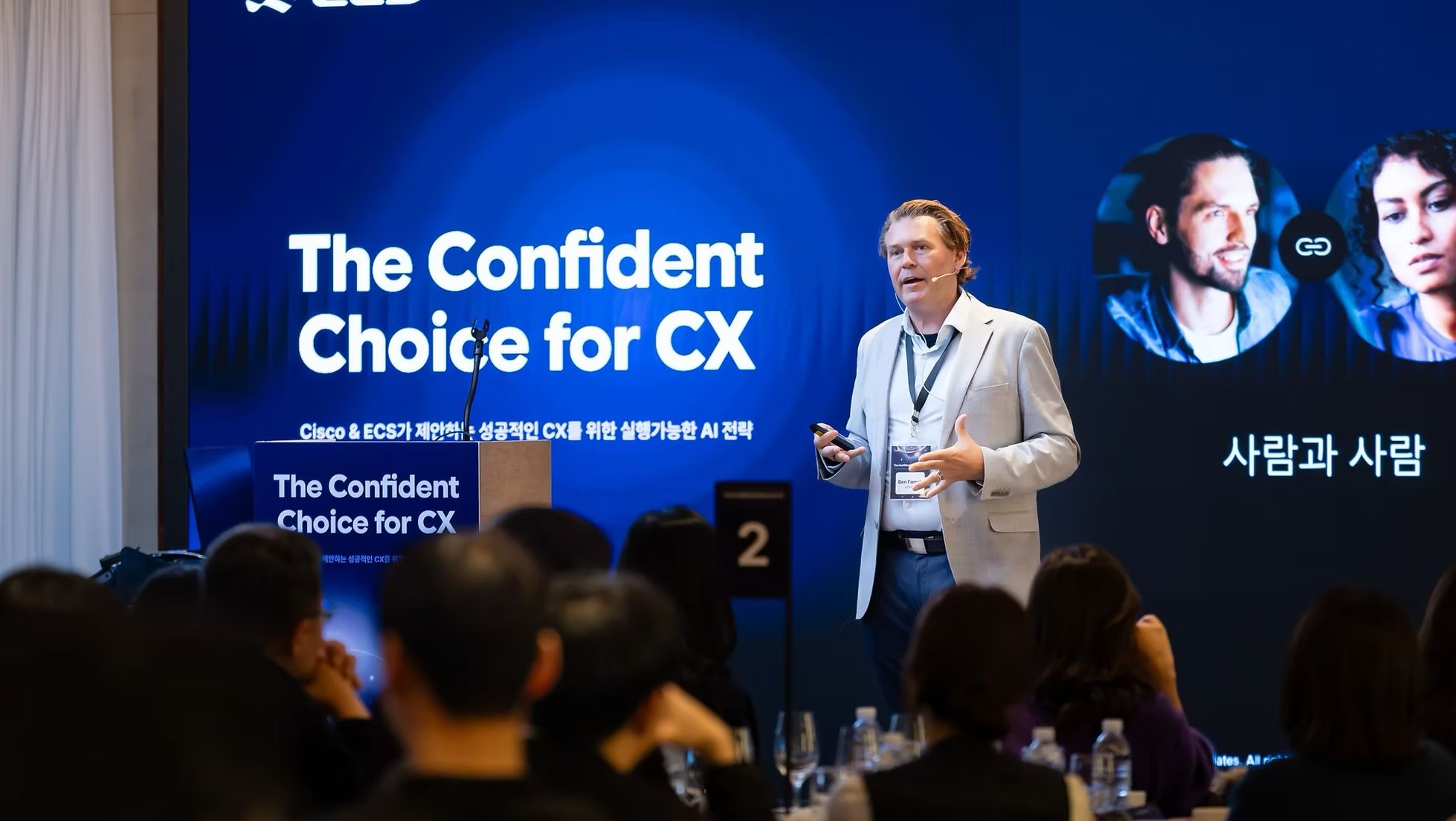
I've spoken directly to Korean enterprise audiences — including at the Getting CX Right event in Seoul, hosted by ECS — and have worked with Korean partners operating across the BFSI and telecommunications sectors. I've met the people running contact centre AI decisions at organisations including Korea Telecom, and understand the specific pressures those teams are navigating: the vendor relationships, the infrastructure legacy, the internal risk appetite, and the language-first AI design requirements that make Korea a genuinely distinctive market.

I also know that a keynote delivered through a real-time translator to a Korean enterprise audience is a different experience from most APJC speaking engagements. The ideas have to be clear enough to survive translation without losing precision. That discipline sharpens the advisory too.

The Korean enterprises I've engaged with are not short of AI ambition or technical capability. What they are navigating is the governance and organisational design question: how do you migrate a contact centre infrastructure built for stability into a model that can support AI-led customer experience, without breaking what already works well? That is a strategy and design problem. It is the problem this advisory is built to help with.

03 / What I help with

Three ways to work together.

01

Pre-investment AI review

A two to three week audit that pressure-tests your AI and CX strategy, infrastructure, and assumptions before major budget decisions are committed. Particularly relevant for Korean enterprises evaluating cloud contact centre migration, domestic vs. international AI platform selection, or Korean language AI design requirements. Output is an executive-ready report with risks, blind spots, and priority moves — delivered in English, structured for Korean enterprise decision-making processes.

02

Executive AI advisory

Ongoing, vendor-neutral advisory for CX and technology leadership teams in Korean financial services, telecommunications, and technology sectors. Covers on-premise migration strategy, Korean language AI design, sovereign vs. international platform trade-offs, and the organisational readiness factors that determine whether AI in CX delivers. Conducted in English. Project-based or retainer.

03

Keynotes & workshops

Executive keynotes and workshops for Korean enterprise audiences on AI strategy, contact centre transformation, and the conversation design principles that determine whether AI performs in production. Available for Seoul-based events, regional conferences, and partner-hosted forums. Delivered in English — with interpreter support available for Korean-language workshop components where required.

Full advisory details
04 / Why independent

No domestic vendor pressure. No global vendor bias.

Korea's contact centre AI market is contested from two directions simultaneously. Domestic vendors — deeply embedded in enterprise infrastructure through long-standing relationships — are defending their on-premise base. International platforms are pushing cloud migration agendas tied to their own revenue models. Both have commercial interests that shape the advice they give.

This advisory practice sits outside both camps. No platform. No integration revenue. No domestic or international vendor affiliations. The question of whether a Korean enterprise should migrate to cloud, adopt a sovereign AI model, or pursue a hybrid architecture is answered by what is right for that organisation's data, customers, and operational context — not by what a vendor relationship prefers. That independence is particularly valuable in a market where the platform selection stakes are as high as they are in Korea right now.

05 / Sectors

Where the AI CX experience comes from.

Twenty years across the sectors most central to Korea's contact centre AI transformation — with direct APJC experience across financial services, telecommunications, and technology.

Banking & Financial Services Telecommunications Insurance Technology Retail & E-Commerce Government Airlines & Travel

Free AI CX diagnostic

Find out which of the six AI archetypes describes your organisation.

Sixteen scenario-based questions. Five minutes. A clear read on the behavioural pattern driving your AI in CX decisions — and what it typically costs.

Take the diagnostic
06 / FAQ

Common questions about AI in CX in South Korea.

Why do Korean enterprises have such a large on-premise contact centre base?

Korea's contact centre sector was built during a period when on-premise infrastructure was the standard, and domestic vendors developed deeply embedded, customised systems that became central to operations in financial services and telecommunications. Data localisation expectations, complex regulatory environments, and a preference for keeping critical infrastructure in-house all reinforced on-premise as the default. The result is a large installed base that is now under significant pressure — because the AI capabilities transforming contact centres globally are predominantly cloud-native, and they are hard to access from on-premise infrastructure.

What makes Korean a uniquely difficult language for AI contact centre design?

Korean is an agglutinative language — words are formed by combining multiple morphemes, creating vocabulary variation that models trained on English handle poorly. More significantly, Korean has a complex honorific system where the entire register of speech changes depending on the relationship between the people talking. Appropriateness in Korean conversation depends on hierarchy, familiarity, emotional context, and social situation simultaneously. Korean AI researchers describe this as a "stress test for context-aware AI" — it cannot be solved by translation or by adding politeness layers to an English-built model. It requires Korean-first design.

Should Korean enterprises use domestic or international AI platforms for contact centres?

It depends on the organisation's priorities — and it is genuinely a more complex question in Korea than anywhere else in APJC. Domestic platforms like SKT's A.X and Naver's HyperClova X have genuine strengths in Korean language understanding and are being actively positioned as sovereign options for regulated industries. International platforms have broader ecosystem integration, faster innovation cycles, and stronger global support. A hybrid approach — domestic models for Korean language AI, international infrastructure for cloud contact centre operations — is increasingly viable and worth evaluating on its merits rather than defaulting to either camp.

Is AI CX advisory available in Korea in English?

Yes. Advisory engagements are conducted in English, which is the working language for international business engagements across Korea's enterprise sector. Ben has spoken at Korean enterprise events including Getting CX Right in Seoul, working through real-time interpretation to Korean audiences — and has engaged directly with Korean partners and enterprise clients across BFSI and telecommunications. Where Korean-language facilitation is needed for workshop sessions in Seoul, that can be arranged through interpretation.

The book

"AI does not define the environment it is deployed into. It inherits it."

Designing AI Conversations at Scale · Ben Farrell

About the book

Start with a conversation, not a contract.

All engagements begin with a confidential discussion to understand your context, your constraints, and what an independent AI CX advisor can actually help with — in Korea and across the APJC region.

Book an advisory discussion